












DemoCampCUSEC4
DemoCamp is an opportunity for you to show off the cool things that you have been working on in your free time. From the next great arcade game, to a new programming language, some of the coolest software is built in your free time, and we want you to show it to us! In DemoCamp the focus is not on slides, or taking about your ideas. It is all about working code. You’ll have 8-10 minutes to show us what you have been working on live in action. We’ll then give you 2-3 minutes to answer questions about your baby.
We’re inviting entrepreneurs and investors to take part in this event. It will be a fun evening of learning, networking and sharing ideas.
We’re still looking for more applications, so if you want to share your pet project with all your peers, drop us a line at chair@cusec.net. Don’t forget to include your name, university, project name and an abstract on your work.
DemoCamp is happening on Thursday 13th January at 7:00 PM at the Marriott Chateau Champlain Hotel (Google Maps)
If you’re a CUSEC delegate, you’re ready to go! If not, please register here so we can have your nametags ready!
Confirmed Presentations
-
PDFtoAudioBook
Presenter: Gina Cook
University: Concordia University
The Android application “PDFtoAudioBook,” allows users to generate an AudioBook from any PDF. It can read any text but it is specifically designed to read textbooks or technical documents so that students or busy people can revise materials on the go. Text to Speech readers are generally very bad at reading formulas, code blocks, mathematical symbols and reading new words like “GUI.” I will demo the use case of giving the application a course syllabus and a PDF of the textbook, having it generate AudioBook chapters to read as the syllabus progresses and having it ask the user to pronounce words that it doesn’t know.
While You Were Sleeping
Presenter: Ashwin Panchapakesan
University: University of Toronto Mississauga
This project accepts an input document and attempts to output its ideas in a minimalistic topic map. Texts with syntax that can be represented in a “noun-verb-noun” model such as lecture notes and newspaper articles fall in the problem domain. This simple syntax allows for parsing with specific structural assumptions. By integrating Python’s NLTK, these assumptions permit part-of-speech tagging.
As a result, fewer words become necessary to parse ideas, since modifying words are found sententially close to their targets. The project presents the parsed document by using tools such as Graphviz, thereby generating an accurate topic map from a text document, an unprecedented achievement. Thus far, visually displaying the generated topic map and parsing more complex sentences (which have larger sentential separation between modifying words and their targets) are challenges for this project. I propose integrating WordNet to enable detection of related words, multi-document-comparisons, semantic noise-filters, and plagiarism detection.
Learn2Learn
Presenters: Aaron Toth, Mythu Sivapalan
University: McMaster University
Learn2Learn is a web application which assists high school students with disabilities better transition to a university learning environment. Using techniques based on cognition theory, Learn2Learn teaches students how to better themselves in an engaging and interactive way. A lot of effort was put forth to ensure that this would be versatile to support every student at McMaster. Several accessibility features were also custom-built for the project, such as a toolbar which provides features like text-to-speech and text highlighting.
More Information: http://learn2learn.ca (the video is a bit out of date, unfortunately)
ChronoLog
Presenter: Jean-Francois Im
Universtiy: École de Technologie Supérieure
Hate timesheets? Can’t remember what you did Tuesday afternoon between those two meetings? ChronoLog allows you to go back in time to look at what you did on the computer this week and remember what you have been working on, just as if you had a time machine — but without those pesky time continuum-breaking paradoxes.
FreeRDP
Presenter: Marc-André Moreau
Universtiy: Concordia University
FreeRDP is a free remote desktop protocol client based on rdesktop. If the rdesktop implementation of RDP is based on works of reverse engineering, FreeRDP is a major rewrite that uses the official protocol documentation released as part of the Microsoft Open Specification Promise. Because of its modularity, cleaner code and newer features, FreeRDP quickly attracted developers, such that it is now in active development. Other projects are being developed in close relationship to FreeRDP, such as xrdp (an RDP server for X11) and Remmina (a graphical front-end to remote desktop clients).
As the founder of an active open source project, I will also share my experience and the story behind it. Even though FreeRDP was started for fun, it grew serious enough so that I could register my own business, Awake Coding Consulting, to offer my services as a software developer. I now have a revenue doing freelance work for my passion.
CMSCart
Presenter: Andrew Mayne
Universtiy: Trent University
CMSCart is an open source content management system predominantly used to generate web stores for various purposes.
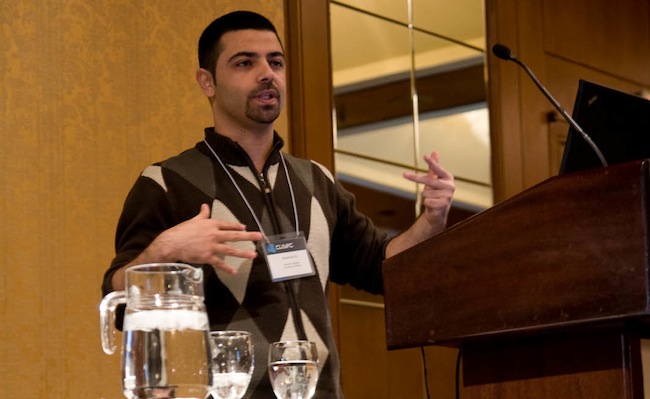
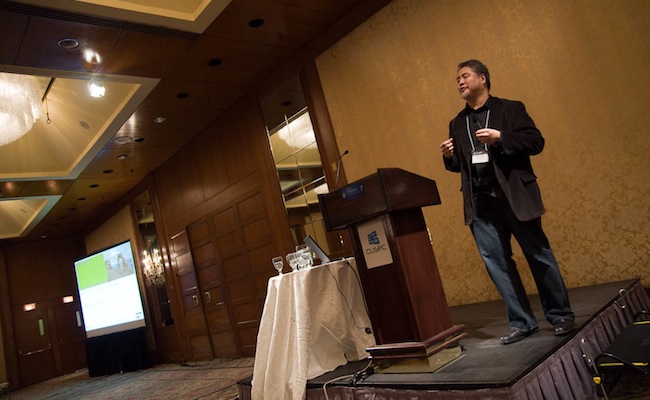
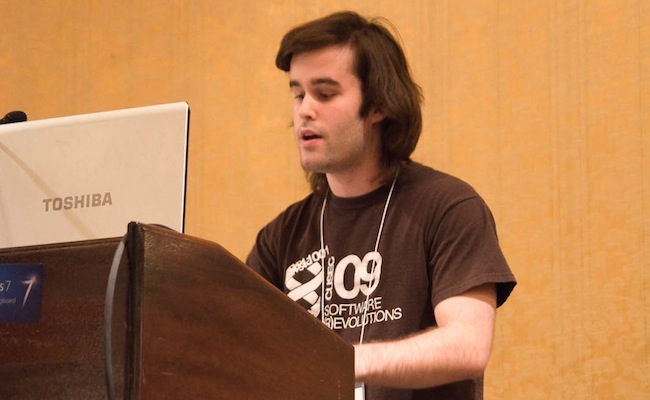
Democamp CUSEC 2010 from CUSEC on Vimeo.